
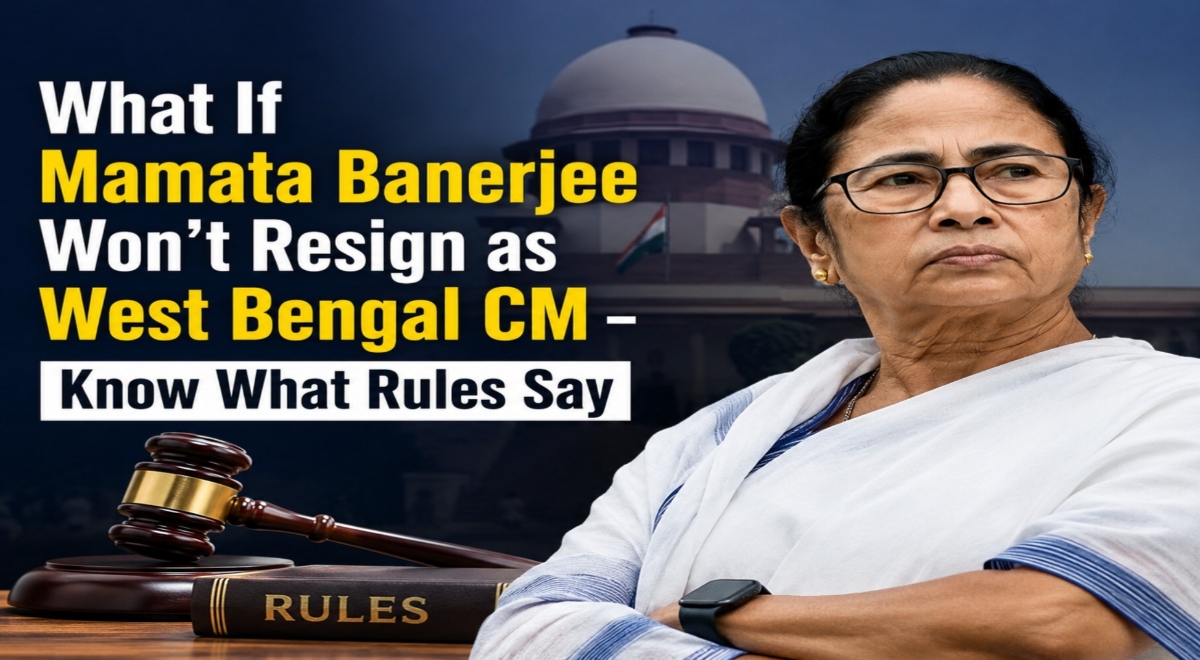
Bhubaneswar (Special Correspondent, The Fact Bureau): A day after the Trinamool Congress (TMC) faced a heavy defeat against the BJP in the West Bengal Assembly elections, Chief Minister Mamata Banerjee said she would not resign, alleging that the polls were not conducted fairly.
While her political stance has sparked debate, the Constitution lays down a clear framework for what happens in such a situation.
What does the Constitution say?
The key provision here is Article 164 of the Indian Constitution, which states that the Chief Minister and the Council of Ministers hold office “during the pleasure of the Governor.”
In simple terms, this means the Governor has the authority to appoint or dismiss a Chief Minister. However, this power is not absolute. Over the years, courts, especially the Supreme Court of India, have clarified that the Governor must act based on constitutional principles and, in most cases, on the aid and advice of the Council of Ministers.
Can a CM Be Removed If He/She Refuse to Resign?
If a Chief Minister refuses to step down despite losing majority support, the Governor can intervene. Typically, the Governor may:
- Ask the Chief Minister to prove majority through a floor test in the Assembly
- If majority is not proven, withdraw support and invite another leader to form the government
- A floor test becomes the deciding mechanism, ensuring that the legitimacy of a government is tested on the Assembly floor rather than through discretion alone.
What If No Government Can Be Formed?
If no party or alliance is able to demonstrate a clear majority, the situation may escalate to the imposition of President’s Rule under Article 356 of the Indian Constitution. This is considered a last resort when constitutional machinery in a state is deemed to have failed.
What Happens When the Assembly Term Ends?
Another crucial factor in this case is the expiry of the Assembly itself. Under Article 172 of the Indian Constitution, a Legislative Assembly has a fixed term of five years unless dissolved earlier.
As per the Election Commission, the current West Bengal Assembly began its term on May 8, 2021, and will automatically expire on May 7. Once this deadline is reached, the Assembly stands dissolved by operation of law. Subsequently:
- The Governor initiates the process to constitute a new Assembly
- Newly elected MLAs take oath
- A new government is formed
Even if Mamata Banerjee refuses to resign, constitutional provisions leave little room for a prolonged standoff. Between the Governor’s authority, the requirement of majority support, and the fixed tenure of the Assembly, the transition to a new government is ultimately governed by established legal processes- not political discretion alone.