
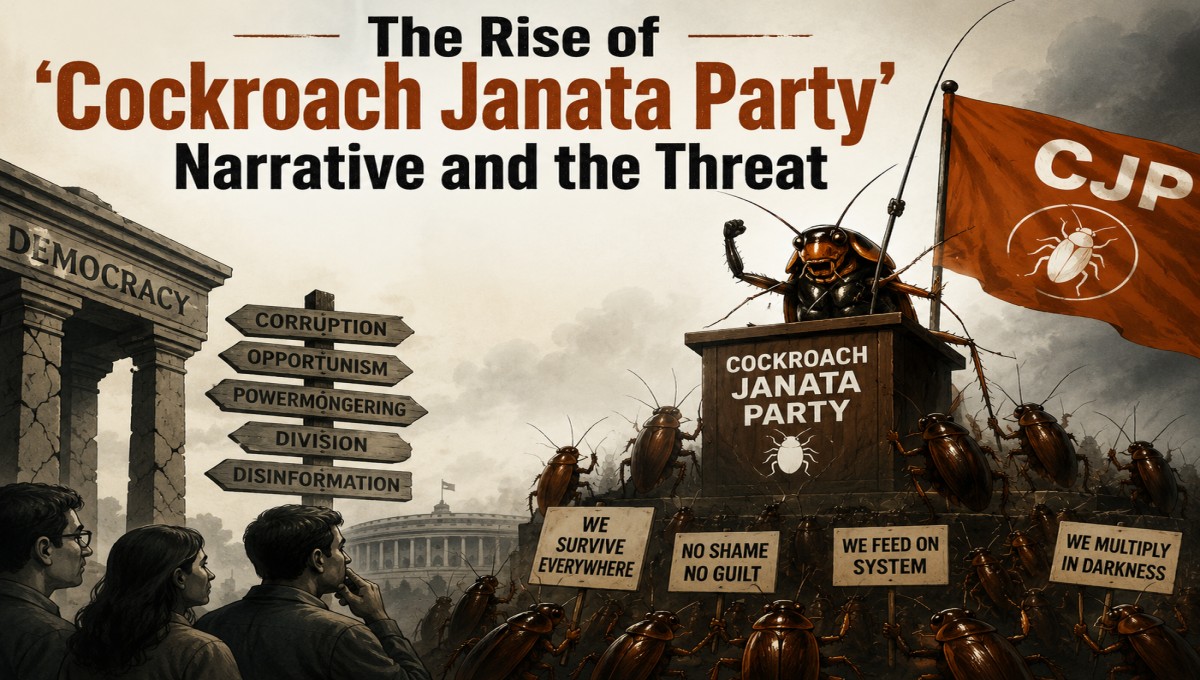
Bhubaneswar (Special Correspondent, The Fact Bureau): Political satire has long been considered a part of democratic culture, but critics now warn that excessive mockery and irresponsible narratives can damage public trust, especially during periods of global instability and economic uncertainty.
One recent example is the spread of the fictional phrase “Cockroach Janata Party,” a sarcastic label used online to mock political systems and leaders who remain in power despite criticism.
The term itself does not refer to any real political party. Instead, it has emerged from internet culture, parody articles, and meme-based commentary.
Read More: BJP Chief Nitin Nabin Praises Mohan Majhi Govt, Calls For Strong Village Outreach
However, many observers believe such comparisons have crossed the line from humor into disrespectful cynicism aimed at democratic institutions.
In recent years, governments across the world have faced extraordinary challenges including inflation, global conflicts, energy shortages, cyber threats, climate disasters, and post-pandemic recovery pressures.
In India too, policymakers have been balancing economic growth, national security, employment generation, and welfare schemes while responding to international tensions and domestic expectations.
Despite these realities, sections of social media continue reducing every political development into ridicule.
The fictional “Cockroach Janata Party” narrative portrays politicians as power-hungry survivors who adapt only to remain in office. While supporters of satire call it freedom of expression, critics argue that constant negativity creates unnecessary hostility and weakens public confidence in governance.
A political communication stated that repeated mocking campaigns can influence younger audiences into believing that every institution is corrupt or meaningless.
“Constructive criticism strengthens democracy, but when satire becomes relentless abuse, it can create anger without offering solutions,” he said.
Read More: BJD Collapsing! ‘Captain’ Naveen Patnaik Struggling to Save the Sinking Ship
Several educators and social commentators have also expressed concern about the normalization of insulting political language.
According to them, reducing public representatives to degrading comparisons discourages serious policy discussions.
Important debates about infrastructure, foreign relations, unemployment, education, and healthcare often get buried beneath viral jokes and online outrage.
Analysts point out that governments, regardless of political affiliation, operate under immense pressure during international crises.
Decisions involving fuel prices, military preparedness, trade relations, and public welfare require long-term planning and administrative coordination.
Simplifying these efforts into mockery may generate online attention, but it rarely contributes to meaningful civic engagement.
Read More: What If Mamata Banerjee Won’t Resign as West Bengal CM – Know What Rules Say
At the same time, democratic societies continue to defend the right to political humour and dissent. Experts emphasize that criticism is essential, but they also encourage citizens to distinguish between informed debate and blanket cynicism.
As India moves through an increasingly complex global environment, many believe the public conversation must become more responsible. Satire may entertain, but when it begins replacing thoughtful discussion entirely, it risks turning democratic participation into permanent distrust.