
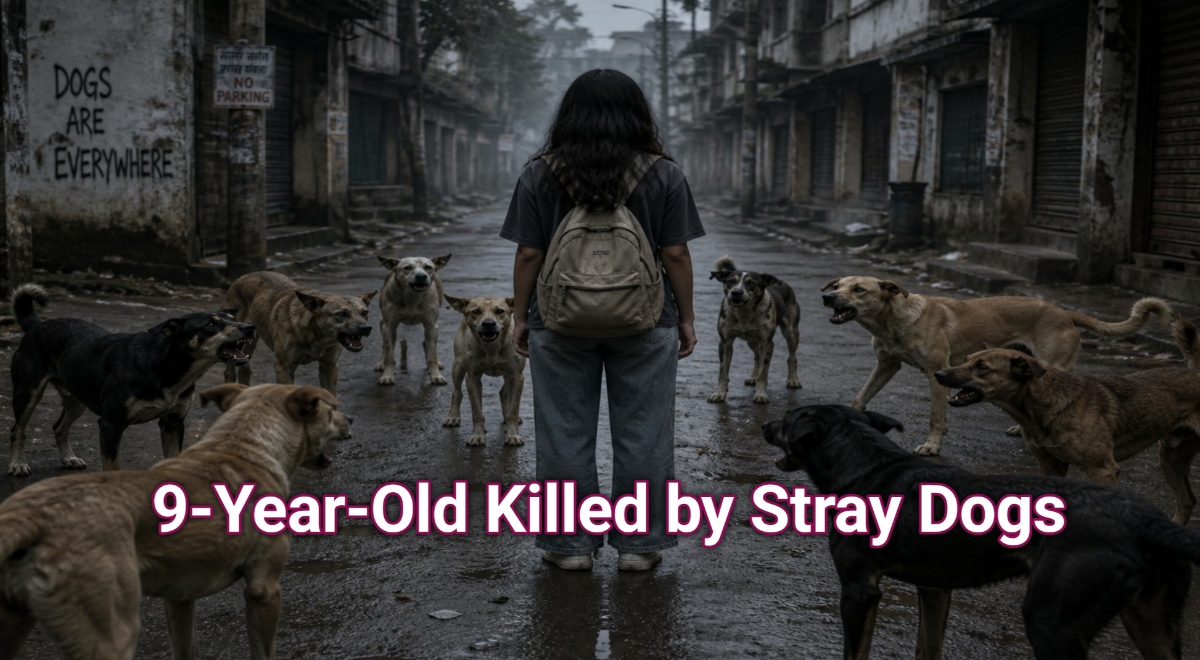
Bhubaneswar (Special Correspondent, The Fact Bureau): In a deeply distressing incident from Rajasthan’s Bundi district, a nine-year-old girl lost her life in a brutal attack by a pack of stray dogs, turning an ordinary morning into an unimaginable tragedy.
The child, Rinku Bheel, a Class 3 student from Alkodia village under Talera police station, had stepped out of her modest home early Monday morning, as she did every day, to relieve herself in nearby fields.
Born into a family of daily wage labourers, her life was marked by simplicity, but it was cut short in the most horrific way.
At around 6 am, she was suddenly surrounded and attacked by stray dogs. The assault was savage, leaving her with severe injuries. Her cries echoed through the quiet village, alerting her family, who rushed to save her. But by the time they reached, the damage had already been done.
She was immediately taken to the Community Health Centre in Talera, where doctors declared her dead. Officials later confirmed the extent of the injuries, describing the attack as extremely severe.
Police have registered a case of unnatural death and completed the necessary legal procedures, including a post-mortem examination conducted by a medical board.
The incident has left the entire village shaken, with grief and anger running deep. For the family, the loss is beyond words- a young life gone, not due to illness or fate, but due to a preventable danger.
Later in the day, Lok Sabha Speaker Om Birla visited the grieving family, offering condolences and immediate financial assistance of Rs 1 lakh. He also assured an additional Rs 1 lakh through public contributions and directed local authorities to extend further support.
Importantly, he called for concrete steps to prevent such attacks in the future.
This tragedy is not an isolated one. Across India, rising stray dog populations and lack of effective management have increasingly put vulnerable lives at risk, especially in rural and underserved areas where basic sanitation forces children and women into open spaces.
In this context, initiatives like the Animal Birth Control (ABC) drives being carried out in cities such as Bhubaneswar gain critical importance. These programmes aim to control stray dog populations through sterilisation and vaccination, reducing both aggression and unchecked growth.
However, experts and citizens alike stress that such efforts must be consistent, widespread, and backed by strict monitoring and accountability.
A coordinated national approach, combining humane population control, waste management, public awareness, and rapid response systems, is essential to prevent such heartbreaking incidents.
Rinku’s death is not just a statistic. It is a painful reminder of gaps that still exist, and the urgent need to close them before another family is forced to endure such irreversible loss.